Cats and Rome
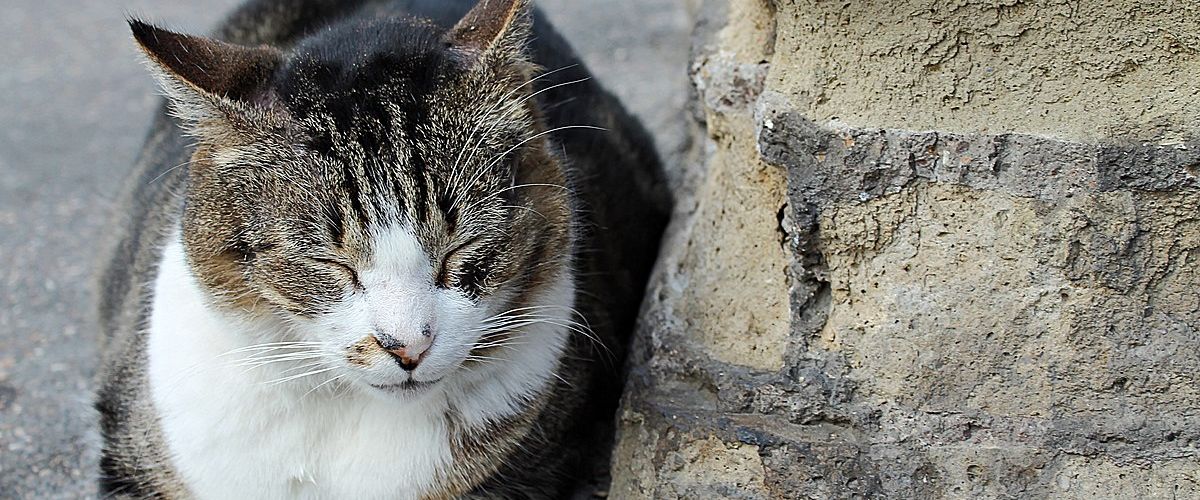
The official animal symbol of Rome is the she-wolf ..however, all it takes is to take a stroll in Rome city center to see the animal that truly dominates the city: it’s majesty the cat.
Street cats are ubiquitous in Rome.
You find them catching the sun in the Colosseum, roaming around the Baths of Caracalla, lounging on cars on the small streets of the Monti neighborhood and pretty much anywhere they feel they can get some food and a place to rest.
In some cases they are friendly and allow you to pet them, in other cases they will run away as you get close. In the vast majority of cases, they simply stay perched wherever they deem fit and look at passers-by with that mix of curiosity and disinterest that is typical of the feline race.
Cats in Rome are protected by law and their safety in the city is guaranteed by organizations and rules aimed at keeping them as free and safe as possible.
There are over 300,000 cats in Rome. Of these, 180,000 live in private homes and 120,000 live as stray cats in cat colonies.
A cat colony is a registered legal entity in Rome, with specific rules. A cat colony can be registered when there is a population of at least 2 cats habitually living in a specific area that they elected as their home.
In 2005, Rome municipality made headlines for their stand on animal rights: these protects not just cats but all pets and includes what is expected of pet shops and owners.
Cats were already protected in ancient Roman times: they were considered sacred to the Goddess Diana and highly regarded as pest control and also as companions, as depicted abundantly in frescoes from wealthy Roman houses in Pompei.
Why so many cats in Rome?
Cats have been in Rome since ancient times. As the population of the city started to grow, so did the population of mice and rats and cats became very quickly a reliable pest control measure as well as a furry companion for wealthy Romans especially.
In Pompei, many frescoes portray Roman women in the company of house cats and it is interesting to see that the Goddess Libertas (Freedom) was often depicted with a cat: this is said to have been in recognition and appreciation of the cat independent spirit, which ancient Roman admired.
Cats were sacred to the Goddess Diana, Goddess of wilderness and who was believed to have gifted cats with special powers.
All this explains why cats became popular in Rome and why they number soared over time.
Is it true cats are protected by law in Rome?
Yes, there is a law that protects stay cats in Rome. Currently, cat protection is defined by law 281 from 1991, however, the legal protection of cats in the city of Rome is nothing new.
Cats were first protected in Rome by law in the I century AD. Legal protection for felines was already typical in Egypt, where cats were considered deities, and Rome followed suit, the link with Egypt being exceptionally strong especially after the conquest of the Egyptian Province by Augustus (this is also the time when Rome acquired its Pyramid, nowadays home to many feral cats).
Law 281 of 1991 states that:
Harming a cat is a crime punishable by law
Cats have a right to live where they choose and it is illegal to forcefully remove them and relocate them from the place they elected as their refuge
Cats have a right to be fed in the place they elected as their home
Local health authority must look after proper neutering of the feline for free
Who looks after the stray cats in Rome?
A group of two more cats regularly living in a specific area is considered a ‘cat colony’ and the person looking after it is usually referred to as a ‘gattara’ (cat lady).
Gattara is a quintessentially Roman concept and a word that describes a woman who looks after numerous cats living in a certain area looking after their needs and the maintenance of health and safety standards of the area the cats live for them and the human population of the area too.
A gattara can be supported by vets and local people in the care of the cats however, this is not always a highly structured role and many gattare are simply women who take upon themselves to look after cats who would otherwise be on their own.
Where can you see cats in Rome?
Cats are pretty much everywhere in Rome however, there are several cat colonies that are so big, you can go visit as a specific attraction. Some of the nicest and easiest to visit for tourists in Rome are:
- Torre Argentina Cat Sanctuary – this is the most famous of all cat colonies in Rome. In the center of Piazza di Torre Argentina lies a large archaeological site, that is a popular refuge for cats.
The site has high historical significance and it is the place where the murder of Julius Caesar took place however, it has been closed to visitors for decades and became the perfect cat shelter for strays.
The presence of cats was a natural occurrence but in 1993, two ladies decided to give structure to their presence here and were able to create a refuge for them where the cats can be looked after and adopted (long-distance or brought home).
The sanctuary is hosted in one of the ancient temples of the archaeological area and has a small souvenir shop so you can go pet the cats and buy something to contribute to the cause.
- Colonia Felina Piramide – another great place to see cats in Rome is Rome’s Pyramid. The Pyramid is surrounded by a green area where cats can roam and borders with the Protestant Cemetery of Rome, which is green and secluded.
- Colonia Felina Verano – Verano is the monumental cemetery of Rome and another great place for cats who roam free among its gravestones and shaded roads.
What if you are allergic to cats in Rome?
All this love and devotion to cats is wonderful if you love felines but what if you don’t?
Don’t let all this talk of Roman cats worry you: while cats are easy to find in Rome, they very much mind their own business and you easily avoid them altogether.
Also, while there are many of them, do not expect a place overrun by them: they are an important part of the cultural and biological landscape of the city, but there is space for everyone!